The Walter H. Gale Professor of Education at the Harvard Graduate School of Education and faculty director of the Center for Education Policy Research, Thomas Kane, joins Paul E. Peterson to discuss Kane’s latest study, which looks into how remote and hybrid instruction impacted students’ learning in the 2020-21 academic year.
LIVE: We need @SummerForPA in Congress to represent the needs of workers, not the wishes of wealthy donors and the billionaire class. Join us NOW for a rally in Pittsburgh, PA ahead of next week’s election.
Older schoolchildren typically perform better on academic achievement tests than younger students in the same classes. Time and again, studies looking at an array of countries, grade spans, and subjects have found that age differences of even a few months do matter.
Consider this example of how age affects academic performance. I look at scores on a standardized math test in Mexico for students in grades 3–9 and group results by students’ birth month (see Figure 1). In every grade, the oldest students, those born in January, perform better than their youngest classmates, who were born 11 months later, in December. These age-based differences mean that, in places with academic tracking, students who are older for their grade are more likely to end up in the more demanding and more academically oriented programs. In comprehensive systems, relatively older students are more likely to attend more selective institutions than younger students—particularly within disadvantaged groups.
Relative age introduces an arbitrary bias that favors older students. And while states and school systems in the United States have mostly ignored this problem, parents consistently step in to try to correct for this bias through “academic redshirting,” or intentionally delaying kindergarten entry by a year (see “Is Your Child Ready for Kindergarten?,” features, Summer 2017). Widespread worries about the practice inspired proposals in Illinois and New Jersey that would ban redshirting, which delays enrollments of an estimated 6 percent of kindergarten students nationwide.
One can only wonder, are relative-age effects on test scores a new trend? Or are they simply a new finding? It turns out that they are neither. These effects are a well-established fact as old as standardized testing itself—and they have been addressed head-on in the past. To see the path forward toward greater fairness in testing, we must first look back at its history.
A New “Mental Test”
On a Friday in June 1921, close to 3,000 students in the primary schools of rural Northumberland, England, were given a new test. It had been developed in the previous months for the purpose of measuring their intellectual abilities. The sheets with the answers were gathered the following Monday, and, two days later, they had all been graded.
Less than three decades later, more than one million such tests were given in Great Britain in 1949 alone. The mind behind this new measure of intelligence was Godfrey Thomson, a towering figure in psychology.
Born in England in 1881, Thomson was of modest means but attended top universities after winning multiple school scholarships based on competitive exams. He trained as a teacher and a scientist, and then entered the field of psychology when he took on the responsibility of training teachers at Armstrong College, Newcastle. One of his lecture topics was the measurement of intelligence.
Meanwhile, about 25 miles north of Newcastle, an intelligence-measurement challenge was vexing leaders in Northumberland. Officials were looking for a fair way to determine which 11-year-old primary-school students would earn what was then the privilege of free secondary-school education. Thomson was invited to help devise a solution.
“It was a problem which had a personal interest for me,” Thomson explained in A History of Psychology in Autobiography, “for I would myself have had no education beyond the primary school had I not won a free place in a secondary school in a competitive examination.”
Competitive examinations had been used to select the region’s secondary-school students for years, and nearly all the spots went to students from a handful of schools near Newcastle. Students who attended primary schools in poor or isolated areas rarely scored high enough to earn a seat. Local educational authorities, who attributed the pattern to differences in students’ home and school environments, sought a new type of test, one that would assess intelligence rather than academic achievement.
“But intelligence tests, it was hoped, might discover in those schools some children of potential secondary school ability even if their environment and their poorer primary schooling had handicapped them in the existing kind of examination,” Thomson wrote.
With this in mind, he created the Northumberland Mental Test to assess students’ verbal and mathematical reasoning ability. Using its results, he selected about a dozen students and gave them free spots in secondary schools “as an experiment.” Those students were followed through the years and, in Thomson’s view, their performance justified the choice.
“Two, alas, died in an influenza epidemic, and two or three failed to complete a good secondary school course, though more I think for social and economic reasons than for lack of intelligence. Others, however, went on and did very well,” he wrote. “Those Northumberland tests of mine were the beginning of a lifelong task, which I have felt bound to persevere in for the sake of intelligent children.”
Word of Thomson’s new exam spread, and soon he received requests from other regions in England to help them with secondary-school student selection. “For these they paid me fees,” he recounted. “I decided that I would safeguard myself from the temptation to make money out of this activity, and I devised a committee to receive all these fees and royalties from my tests.” By 1925, Thomson had become an educational psychologist at the University of Edinburgh, and the exams were known as the Moray House Tests. The revenues they generated went to research on standardized testing.
In 1932, a Moray House Test was given to practically all Scottish children born in 1921—roughly 90,000—as part of a national intelligence measurement effort called the Scottish Mental Survey. A similar survey was conducted in 1947 among children born in 1936. Those surveys are landmarks and have allowed researchers to study the relationship between intellectual abilities and other variables that include health behaviors, socioeconomic mobility, and life satisfaction. In 1949, Thomson was knighted by King George VI for his contributions to education.
Godfrey Thomson, a towering figure in psychology, created the Northumberland Mental Test to help assess students’ math and verbal reasoning abilities.
Age Allowances in Action
Thomson’s tests were designed to measure aptitude and to unravel the tight connection between school assignments and social status. But they also revealed another sort of advantage: the boost conferred by age in tests that attempt to measure the intellectual ability of schoolchildren. In order to make appropriate comparisons across students, it was necessary to account for age differences, even if they were of just a few months. So Thomson included a formula that adds or subtracts a few points for every month of age in how each student’s Intelligence Quotient is calculated. This adjustment became known as the “age allowance,” and it is based on the average increase in the test score that would result from the same student taking the test at a slightly different age.
An age allowance is a simple idea. Think of the growth charts that pediatricians use to assess the height and weight of a child, which track those measures by the child’s age, in months. To create that chart, someone collected information from many children and recorded their exact age. With many observations, it is possible to compute an average score for every age in months. The age allowance is simply the adjustment for the trend in scores due to age.
It was also a pioneering development. In 1959, psychologist P. E. Vernon lauded Thomson’s achievement, writing, “If one were asked to name one field in which Thomson was the undisputed pioneer who led the rest of the world, it would be the standardization, and application of age-corrections to, mental tests.” Thomson “perfected the technique of determining the appropriate age correction for each month-group to which the test was applicable without having to collect enormous samples of each month of children.”
This scoring method was not without controversy. In 1953, the British newspaper the Guardian (then called the Manchester Guardian) reported on some of the grievances parents had with respect to the process for determining which students would attend selective secondary schools, known as “grammar schools.” One specific complaint was that the age allowance gave “below-average youngsters preference over above-average older pupils who, in the considered opinion of schoolmasters, would do better at grammar school.” The newspaper explained:
To this accusation the experts blandly plead guilty—while at the same time protesting that their age-allowance (which may be as much as twelve or fourteen per cent) is scrupulously fair and accurate. […] Where, then, lies the catch? Simply in the fact that no allowance is made for age at any other stage in the schoolchild’s career.
In other words, age allowances make admissions fairer, but students who benefit from them tend to do worse than those who don’t. That is not because they are worse students; rather, it’s because such allowances don’t follow students into the classroom. Once they are admitted, students “thereafter take all internal and external examinations at the same time, and the younger would never again get an age allowance.”
That insight applies today just as it did seven decades ago. Leveling the playing field in admissions doesn’t erase the differences in test scores and GPA after admission. On average, younger students will still perform worse than their older classmates.
In this context, then, it is crucial to clarify the purpose of using tests scores in admissions. Is it to fairly select talented students or to predict which students will perform better? If what matters is “the accuracy with which [a test] predicts performance,” the Guardian article continued, “no allowance should be made for age and admissions will be heavily weighted in favour of children born in the right months. But so long as admission to a grammar school is regarded as a privilege to be competed for, such a criterion would be manifestly unjust.”
So long as admissions exams are intended to fairly apportion opportunities to talented students, age allowances are appropriate. In Thomson’s words, “The object of an age allowance is not to improve prediction, but to do justice to children born in different months of the year.”
Impacts on Equity
The questions raised by the Guardian article make many educational authorities reluctant to adopt age adjustments in test scores. Yet the broader point is that there is unfairness in all measures of academic performance that don’t take into account age differences between classmates. Age-adjusting test scores used for admission purposes is a step in the right direction. But it doesn’t address by itself the handicap suffered by younger students in later tests or grading.
Still, it’s better to improve fairness in admissions even if the playing field is not leveled in other indicators of academic achievement. The fact that an institution, a school district, or a country cannot fix all the distortions introduced by relative age doesn’t mean it shouldn’t fix some of them. Partially fixing the problem is better than not fixing any of it. Plus, there is evidence of benefits from this approach.
In 1944, a sweeping set of new rules made important changes to broaden educational opportunity throughout England and Wales. The Education Act of 1944 raised the age of compulsory schooling to 15, made secondary schools free to all, and brought church-run schools into the national system. All students were required to take a competitive admissions exam after age 11. Many schools started using the Moray House Tests, which included an age allowance.
Economists Robert Hart and Mirko Moro analyzed how the enrollment of children into grammar schools changed as a result of the reform. Before 1944, children born from January to August—the middle or end of the school year—were less likely to find a grammar-school spot than their older classmates, who were born from September to December. After the reform, students born in the middle of the year were far more likely to get a grammar-school spot, which Hart and Moro argue was due, in part, to the growth in the use of age allowances. In other words, the adoption of age allowances increased the admission rates of students who, based on their month of birth alone, would have otherwise been excluded.
The modern-day relevance of these discoveries from the past century is not hard to find. Consider a test like the ones used by school districts in Boston, Chicago, or New York City to admit students into selective public high schools. If students who are 14 years and 11 months old on the day of the test score two points higher, on average, than students who are 14 years and 10 months old on test day, their ultimate test performance should account for that age-based difference. This applies to college admissions tests, as well—not only the SAT and ACT in the U.S., but also the Gaokao in China, Vestibular in Brazil, Suneung in South Korea, Exani in Mexico, and so on. Thomson’s work shows that the creators and administrators of these tests can accurately measure what correct age allowances should be, based on the unique context of the exam and the students.
Hazards Ahead
If age allowances increase fairness and are feasible—proven by Thomson a century ago—shouldn’t they be more popular? Why don’t we see them in more education systems? First, the belief that age differences of a few months stop mattering early on in academic contexts is as widespread as it is incorrect. But I see another culprit as well. Even if some stakeholders are aware of the effects of relative age, there is a collective action problem.
No institution or school district operates in isolation, and many use the same or similar admissions exams. So adopting age allowances unilaterally may be a bad idea. Imagine that one selective school decides to make an “in-house” age allowance in its admission process while comparable institutions don’t, but they all use the same test. The institution adopting the age allowance would experience a drop in unadjusted test scores. Of course, admissions to that institution would be fairer. But the average quality of incoming students as measured by test scores would look worse relative to both past incoming classes and peer institutions.
Age allowances could hurt the ranking of an institution—a high price to pay in a hypercompetitive environment in which even prestigious institutions like Claremont McKenna College and Emory University have falsely inflated the average SAT scores of their incoming freshman classes to publications like U.S. News & World Report to boost their public profiles. Greater numbers of relatively young students would be admitted while greater numbers of relatively old students would be rejected, bringing the average unadjusted SAT scores down. Despite a growing movement toward “test-optional” admissions, average SAT scores remain a high-profile metric for many institutions, and any school that adopted age allowances would mechanically fall in college rankings. It’s unlikely that any one institution, even if interested in fairness in admissions, would want to be the first to adopt age allowances.
However, not all stakeholders in the realm of standardized testing have the same interests and concerns. To overcome our collective action problem, we can make age allowances at the source. Test creators and test administrators don’t face the tradeoff between fair admissions and institutional ranking. They also observe all test takers and are well-positioned to determine how big or small the “bump” to younger students should be. They can follow Thomson’s lead and account for this by design.
To gauge the potential impact of introducing age allowances, we can look at recent test scores in England on two grammar-school admissions exams. Though these “11+” exams are used for admissions at all 160 grammar schools in England, different regions and schools use different tests. Not every test used includes an age allowance, despite the longstanding precedent to do so.
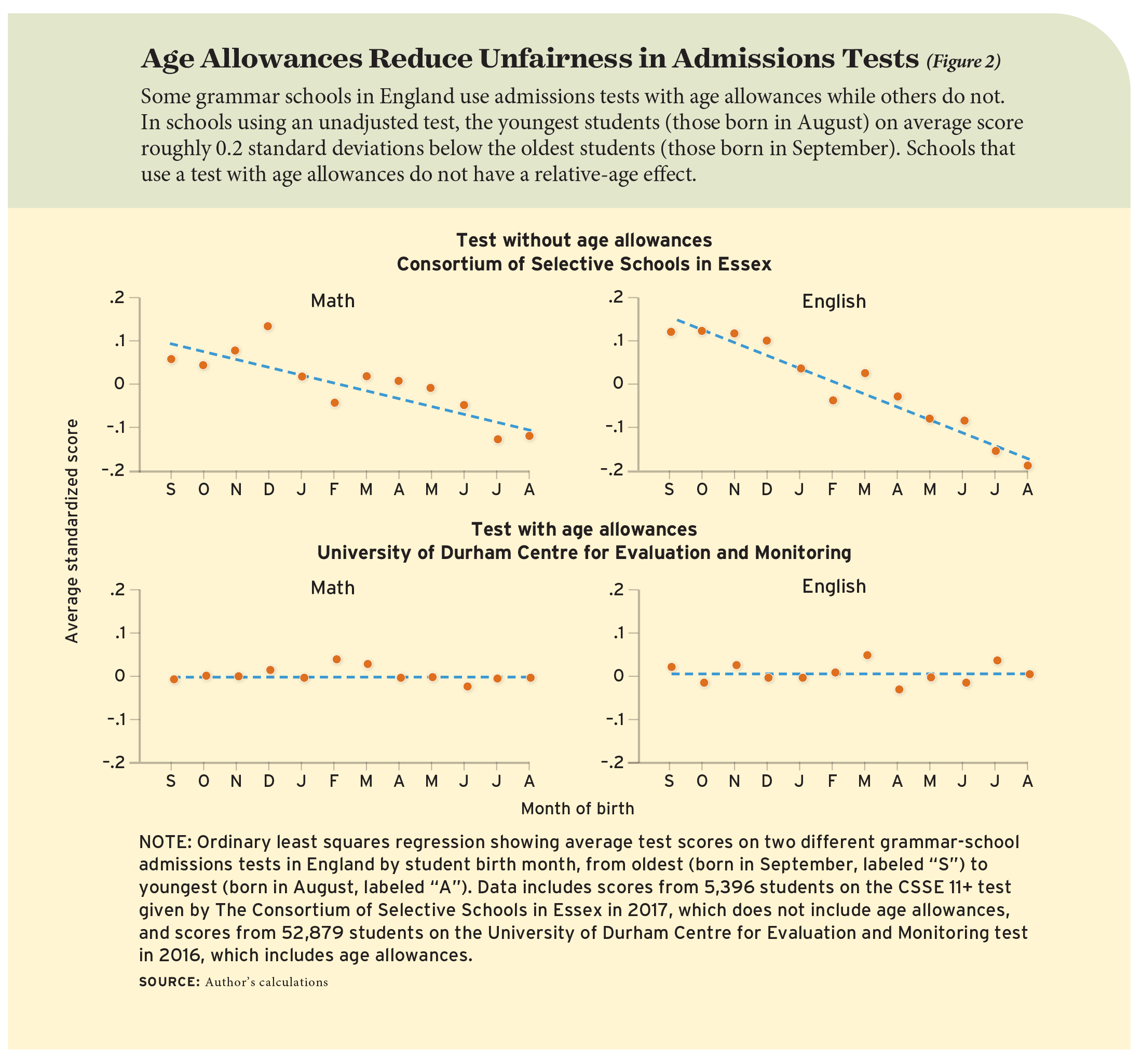
I look at average student scores on two tests: one administered by the University of Durham’s Centre for Evaluation and Monitoring, which includes age allowances, and one administered by The Consortium of Selective Schools in Essex, which does not (see Figure 2). In the Essex schools using the unadjusted test, the youngest students, who were born in August, score roughly 0.2 standard deviations below the oldest students, who were born the previous September. By contrast, we do not see such differences on the age-adjusted tests.
Admissions that use unadjusted scores obviously penalize students born in August relative to those born in September. But they also penalize students born in July, June, and so on, all the way to October, though to a lesser extent. Even in the same country and in the same admission process, not all schools are in the age-allowance wagon that departed Northumberland in the 1920s.
The Case for Extending Age Allowances
Age allowances have a proven track record and should be included in any test for which there is indication that age matters. There is clear evidence that age makes a difference in the measurement of intelligence until at least age 18. Just as important, there is also evidence of the effects of age on the SAT and ACT, the two most popular college admissions tests in the U.S. For example, a study by Steven Hemelt and Rachel Rosen found that 12 months of age bump scores on the ACT by as much as three percentiles. According to my preliminary analysis of the impact of age on SAT scores, students who retake the test one year after their first time gain about eight percentiles. To be sure, second-time testers may be more familiar with the SAT format and have undertaken more preparation than students sitting for the test the first time. But given the impacts of age on test scores we saw in Figures 1 and 2, the fact that they are one year older also would seem an important factor.
Recent moves by a growing group of prominent U.S. institutions to make standardized test scores an optional part of student applications won’t make life easier for relatively young applicants. College admissions officers are focused on other signs of talent, and those signs are also biased by age. For example, one analysis of GPA among high-school seniors shows that relatively younger students are outperformed by their older classmates. To correct for this bias, age allowances could also be made in subject-specific grades as well as any academic achievement test whose score is used to award entry into competitive programs, compare performance, or give feedback to students and families.
Age allowances could also reduce academic redshirting by removing families’ incentive to delay kindergarten. This isn’t a minor point. At a societal level, redshirting is a wasteful practice. Essentially, it is a zero-sum game, since there will always be younger and older children in the same school class. Equally important, since redshirting is more prevalent among white children from high-income families, it contributes to the gaps in test scores observed along income and racial or ethnic lines. By making redshirting less appealing, age allowances could simultaneously save resources and help level the playing field—a rare chance to enhance efficiency and equity at the same time.
An age allowance is neither a new nor a radical idea. Allowances are as old as standardized tests themselves, and they were born with the measurement of intellectual ability of children. And, above all, including them in high-stakes measures of intellect or academics is the fair thing to do. In the words of Thomson, “Age allowances are sometimes, by those opposed to them, called a premium on youth. They are not that. When scientifically applied they are a device to compensate for the unfair premium on age.”
Pablo A. Peña, who was born in January and started school a year early, is Assistant Instructional Professor at the Kenneth C. Griffin Department of Economics at the University of Chicago.
By: Pablo A. Peña Title: End the Birthday Bias Sourced From: www.educationnext.org/end-the-birthday-bias-age-allowances-high-stakes-tests-proven-boost-fairness/ Published Date: Tue, 10 May 2022 09:00:12 +0000
The executive director of the Pioneer Institute, Jim Stergios, joins Paul E. Peterson to discuss the current state of Boston Public Schools, and whether control of the district should be taken over by the state.
Over the past two years, the nation’s school boards have had to grapple with one thorny controversy after another. Local news reports, op-ed pages, and viral social-media posts have featured outraged parents and advocates protesting the presence of armed police officers in schools, the use of entrance exams for selective programs, mask mandates for in-person learning, and allegations that Critical Race Theory was infiltrating the K–12 curriculum.
These displays of activism and acrimony took place at a time when local school officials were tackling two of the weightiest policy questions in recent memory—how to make up learning lost during the most prolonged and widespread instance of school closures in American history and how best to spend an unprecedented infusion of federal relief dollars. The apparent disconnect between the issues that adults seemed most riled about and what was at stake for students did not escape notice. In January 2021, the San Francisco school board voted to remove the names of presidents Lincoln and Washington (among other historical figures) from district schools because of their supposed roles in perpetuating slavery and racism, even as those same buildings remained vacant and students were still learning remotely. San Francisco Mayor London Breed pleaded, “Let’s bring the same urgency and focus on getting our kids back in the classroom, and then we can have that longer conversation about the future of school names.”
The events of the past two years underscore a question that has long been a subject of debate among education-policy researchers and reformers: Is our school-governance model—featuring decentralized control and locally elected school boards—the most effective and efficient approach to educating America’s youth? In a seminal book published 30 years ago, Politics, Markets, and America’s Schools, John Chubb and Terry Moe argued that it is not. Presaging many of the dynamics on display recently, Chubb and Moe warned that institutions of democratic control—meaning locally elected school boards—often fail in carrying out their core missions, instead empowering vocal and well-organized adults at the expense of the educational needs and interests of students, who do not get a vote in local elections.
With three decades of additional evidence and the pandemic still disrupting business as usual in our schools, now is an opportune time to revisit their arguments. Much has changed in the education world over the past 30 years, and new data sources and research methods have revealed the inner workings of local democracy in much greater detail than was possible when the book was written. Nevertheless, Chubb and Moe’s conclusions have aged surprisingly well. Their central thesis—that local democracy fails to incentivize pivotal policymakers to give priority to students’ academic needs—has been confirmed by a growing body of research on school-board elections. Indeed, increasing partisan polarization over educational issues and the changing demographics of American society have only exacerbated these governance challenges. The pandemic served as a worrying stress test of school governance in America, bringing popular attention to many of the issues Chubb and Moe first highlighted in their work.
Satan and the Origins of “Local Control”
Chubb and Moe’s central thesis has been confirmed by additional research.
Some critics of Politics, Markets, and America’s Schools attacked the book for being “openly antidemocratic.” Presumably, these detractors believed that local democracy is the default or preferred mechanism for running public schools, but in much of the developed world, schools are typically overseen by centralized national agencies. In fact, our model is largely a historical artifact, dating back to the first public-education law adopted in the Massachusetts Bay Colony in the mid-1600s. As evident from the law’s title, the Old Deluder Satan Act, it was the moral concerns of adults, rather than a desire to address the holistic educational needs of children, that mainly drove the public-school effort—not unlike some of today’s battles over sex education, intelligent design, and social-studies curricula.
The Massachusetts law, which charged local government with the responsibility for funding and operating local schools so kids would become literate enough to read the Bible, was copied across the country in one of the earliest examples of what political scientists now call policy diffusion. Over the course of the 20th century, this system underwent several important transformations. The shift from single-room schoolhouses to grade-banded schools necessitated consolidation into larger school systems, moving the locus of political control from boards overseeing individual schools to districtwide bodies. At least in theory, the emerging norm of appointing professionally trained superintendents to oversee day-to-day operations limited the influence of elected school-board members. Starting in the 1970s, lawsuits over funding inequities massively increased state-government investment in K–12 education, giving state lawmakers greater say in public-school policy. And over the past three decades, state and federal reforms greatly increased transparency over student outcomes and ratcheted up accountability pressures designed to improve student achievement.
As this history shows, our system of “local democratic control” was not intentionally designed with student academic outcomes in mind and has become less local (and perhaps less democratic) over time. Nevertheless, elected school-board members still occupy a central policymaking role, with final say over teacher contracts, curriculum choices, disciplinary policies, and many other important issues. Recent research shows that who serves in these positions is consequential for students. When voters elect more nonwhite school-board members, districts diversify their staffs, increase investment in facilities, and narrow racial achievement gaps. Similarly, school boards with more Democrats appear to decrease racial segregation, while greater teacher representation on these bodies leads to lower charter-school enrollments and higher teacher salaries.
Student Achievement and School-Board Elections
Although who wins a particular school-board contest can matter a great deal, there’s little indication that voters use elections to hold school boards accountable. A study by Christopher Berry and William Howell found that voters in South Carolina appeared to reward school-board incumbents for improvements in student test scores in 2000, when the scores first became public (see “Accountability Lost,” research, Winter 2008). However, media attention to test scores faded in 2002 and 2004, and so did electoral accountability. In an analysis focused on the introduction of “report cards” for schools in Ohio, which I conducted with Stéphane Lavertu and Zachary Peskowitz, we found little evidence that highly publicized performance indicators affected the outcome of school-board elections in the state. In California, voters do appear to hold school-board incumbents responsible for student learning—but only when school-board elections are held concurrently with presidential contests and turnout is high.
Even in the rare cases where student achievement does matter for school-board elections, the effects have been surprisingly modest, typically increasing or reducing the share of votes won by individual candidates by fewer than 5 percentage points. This differential is far lower than the margin of advantage enjoyed by incumbents in local races, and it appears to be a fraction of the electoral boost conferred by securing the teachers union endorsement. If school boards are asked to choose between a policy that improves student achievement and one that benefits teachers, the pressures of seeking reelection perversely encourage school-board members to prioritize adult employees over the education of students. These dynamics are likely amplified in large, urban districts, where teachers unions tend to enjoy stronger organization and access to greater political resources.
Some might argue that the interests of teachers and students are necessarily aligned, and perhaps this is true in many cases. However, the pandemic provided a clear counterexample. Fortunately, Covid-19 resulted in relatively mild infections for most school-aged children who contracted the disease—on par with seasonal influenza—but it was far more dangerous for school employees. Although few school-board members publicly acknowledged it, the decision about whether to resume in-person instruction in fall 2020 involved a difficult tradeoff between providing the best learning opportunities for students and minimizing the health risks for workers. There is little doubt that in cities including Chicago, Los Angeles, San Francisco, and Washington, D.C., organized opposition from teachers unions delayed the return of students to their classrooms, although it is less clear how much of this was attributable to union political influence rather than the obstruction opportunities built into the collective-bargaining process.
Are Voter and Student Interests Aligned?
Parents account for a larger share of the electorate in even years, when high-profile national races appear on the ballot, which could be why school-board members seem to face more pressure to improve student outcomes in those years. The conventional wisdom is that off-cycle school-board elections—a practice established by Progressive reformers early in the 20th century—increase the influence of school employees and their unions because most other voters stay home. More recent research, which takes advantage of the growing availability of electronic voter-turnout records and big-data methods to link these records to other information (including teacher-licensure databases), suggests that such concern about off-cycle elections may be exaggerated. Even in exceptionally low-turnout elections, school employees account for a relatively small fraction of voters. Of course, unions influence election outcomes through mechanisms other than voting—including endorsements, campaign spending, and neighborhood door knocking. These strategies may well have a greater impact on lower-turnout elections, though there is no compelling empirical evidence that they do. But the research does suggest reasons other than union influence to doubt that the interests of school-board voters and students are likely to be aligned.
In several recent papers examining school-board elections in various large states, my coauthors and I found that voters who turn out in these elections typically do not have kids of their own and are generally much whiter as a group than the students that local schools educate. Indeed, we showed that most of the school districts with majority-nonwhite student bodies in these states were governed by school boards elected by majority-white electorates—in many cases, overwhelmingly white electorates. Particularly in low-turnout elections, elderly white voters without children appear to be the pivotal voting bloc, and there is little reason to believe that these voters are any more motivated to improve student outcomes than school-employee interest groups are.
The experience of the East Ramapo Central School District, which was profiled in an episode of the public-radio series This American Life, illustrates the downsides of a system in which education policy is dictated by voters who do not look like the students that the policies affect. The district is in a racially diverse suburb in New York state. While two thirds of its residents are white, Black and Hispanic students account for 92 percent of school-district enrollment. Orthodox Jews make up much of the population and tend to send their kids to private religious schools—which enroll far more students than the public district does.
According to recent litigation, white voters effectively control the East Ramapo school board, even though few of their kids attend the public schools. District court judge Cathy Seibel found in 2020 that the school district’s at-large election system was essentially “diluting” the Black vote. The district has advantaged the interests of white residents and the private schools their kids attend: keeping property taxes and instructional expenditures to a minimum, generously funding special-education services for private-school students, and selling off public-school buildings to private religious schools. Although this is an extreme example, the underlying representational problems and perverse incentives created by local democratic control in East Ramapo play out in a broad set of school districts—especially those serving mostly students of color—where the interests of voters and public-school students are likely to be out of sync.
Revisiting Chubb and Moe
The worrying findings documented in the research—that school-board members face minimal electoral pressure to improve student outcomes, that they are often cross-pressured by employee interest groups, and that they do not prioritize the interests of minority-student populations—is largely confirmed by school-board members themselves. In one recent survey, nearly 40 percent of incumbent school-board members reported running unopposed in their last election. In other surveys, school-board candidates identified teachers unions as some of the most active and influential actors in school-board elections. Another recent survey, using a clever design meant to elicit honest responses to sensitive questions, asked California school-board members to identify considerations important to voters. Forty percent of respondents said they felt no electoral pressure from their constituents to close racial achievement gaps. One can think of no stronger endorsement for Chubb and Moe’s critique of local democratic control.
In several important respects, the challenges of education governance have evolved over the past three decades. In identifying the mechanisms through which electoral politics can impede the provision of high-quality education, Chubb and Moe focused primarily on entrenched employee interest groups and sclerotic bureaucracies. They put less emphasis on two other factors—partisan polarization and identity politics—that have become much more salient in education-policy debates today.
The late 1990s and early 2000s were a high point of bipartisan consensus on education reform. Elites from both parties supported standardized testing, holding schools and educators accountable for student performance, increasing school-choice opportunities for families, and the need for dramatic turnaround of chronically underperforming schools. This consensus began to unravel during the highly partisan debates over the Common Core standards, and divisions over reform intensified during the Trump years. The impact of this polarization was seen clearly during the pandemic, when local partisanship—rather than Covid case counts or hospitalization rates—emerged as the strongest predictor of whether local schools resumed in-person learning in fall 2020.
Chubb and Moe also arguably underestimated the importance of race in local education politics. Members of minority groups, who have historically faced discrimination in the private labor market, have long relied on government jobs. Especially for Black Americans, such work has provided an important source of upward economic mobility. In cities such as Baltimore and Washington, D.C., local school systems supplied well-paying, middle-class jobs for Black families. Sometimes, well-intentioned school-improvement efforts put these jobs at risk, undermining support for reform among not only the affected school employees but also other prominent Black community leaders, including clergy.
Such dynamics have played out recently in New Orleans, where Hurricane Katrina triggered a state takeover and a wholesale overhaul of local schools that created the nation’s first all-charter district. Rigorous evaluations have shown that these reforms dramatically improved student achievement and substantially increased rates of high-school graduation and college attendance and persistence, with the largest gains in educational attainment for low-income and Black students (see “Good News for New Orleans,” features, Fall 2015). However, the reforms also led to significant job losses for the city’s majority-Black teacher workforce, perhaps explaining why Black residents were ultimately less supportive of changes in school governance and were less likely than white residents to say that schools had improved as a result.
Public-opinion surveys during the pandemic documented similar racial polarization in opinion on schools, with parents of color far more likely to prefer keeping their children learning online and less likely to opt for in-person opportunities when schools did reopen in the largest cities. Although these racial gaps narrowed over time, some interest groups attempted to weaponize the racial disparities in the political battles over the pace and timing of decisions to reopen. When California lawmakers offered districts financial incentives to resume in-person learning, for example, the Los Angeles teachers union called the move “a recipe for propagating structural racism.” Race has also figured prominently in debates on issues related to school discipline, school resource officers, and selective-admissions schools.
On the other hand, Chubb and Moe arguably overestimated the extent to which market-based mechanisms could correct many of the school-governance problems they identified. Since the publication of their book, both private-school vouchers and charter schools have introduced important elements of market forces to the education ecosystems in many states. Particularly in urban areas, charter schools have posted substantial achievement gains, although charters continue to educate a relatively small share of students outside of a few cities such as New Orleans, Detroit, and Washington, D.C. Competition from charter schools and private-school choice has also led to modest improvements among public schools, although competition has hardly proved to be a panacea for most underperforming school systems.
Without Reform, Things Will Only Get Worse
As discouraging as recent trends may seem, the governance challenges are likely to grow worse in the absence of meaningful reform. The decline of local newspapers will further erode watchdog journalism and oversight, perhaps reducing voters’ access to independent information on student performance. The nationalization of local politics will continue, making partisan polarization over local education issues even more intense. The growing diversity of public-school students—a population that became majority nonwhite in 2014—will likely further increase the demographic disconnect between school-board electorates and students. The aging of the general population will bring intergenerational conflict—sometimes described as the coming “gray peril”—over school funding. Finally, the substantial enrollment losses seen during the pandemic will likely accelerate the decline in public-school enrollment, exacerbating local political battles over school closures and distracting attention away from academics.
Fortunately, the pandemic may also help open the door to transformative change. If history is any guide, substantial test-score declines in the coming years will push educational concerns higher on the national policy agenda and help mobilize support for reform. The infusion of federal funding will provide a welcome defense against the oft-repeated argument that lack of resources and disinvestment are the main barriers to boosting student achievement in the most-disadvantaged communities. When the policy window opens, reformers should remain laser focused on improving school governance—to ensure that the reform process prioritizes the interests of kids rather than the demands and political agendas of adults. Such reforms should include holding school-board elections on cycle, when participation among parents is highest; reworking accountability systems to ensure that district-performance ratings emphasize each school’s contribution to student learning rather than the demographic mix of students it serves; and timing the release of school ratings to coincide with school-board election campaigns. Every crisis brings an opportunity, and we cannot afford to let this one go to waste.
Vladimir Kogan is associate professor at The Ohio State University.
A professor of economics at Duke University, Peter Arcidiacono, joins Paul E. Peterson to discuss Arcidiacono new study, which examines how racial preferences for under-represented minorities affected admissions to Harvard University and the University of North Carolina at Chapel Hill.
What can we learn from Norway? I spoke to Norway’s Ambassador to the U.S. this week about what it’s like living and working in her home country. Join us.
 The Walter H. Gale Professor of Education at the Harvard Graduate School of Education and faculty director of the Center for Education Policy Research, Thomas Kane, joins Paul E. Peterson to discuss Kane’s latest study, which looks into how remote and hybrid instruction impacted students’ learning in the 2020-21 academic year.


 Older schoolchildren typically perform better on academic achievement tests than younger students in the same classes. Time and again, studies looking at an array of countries, grade spans, and subjects have found that age differences of even a few months do matter.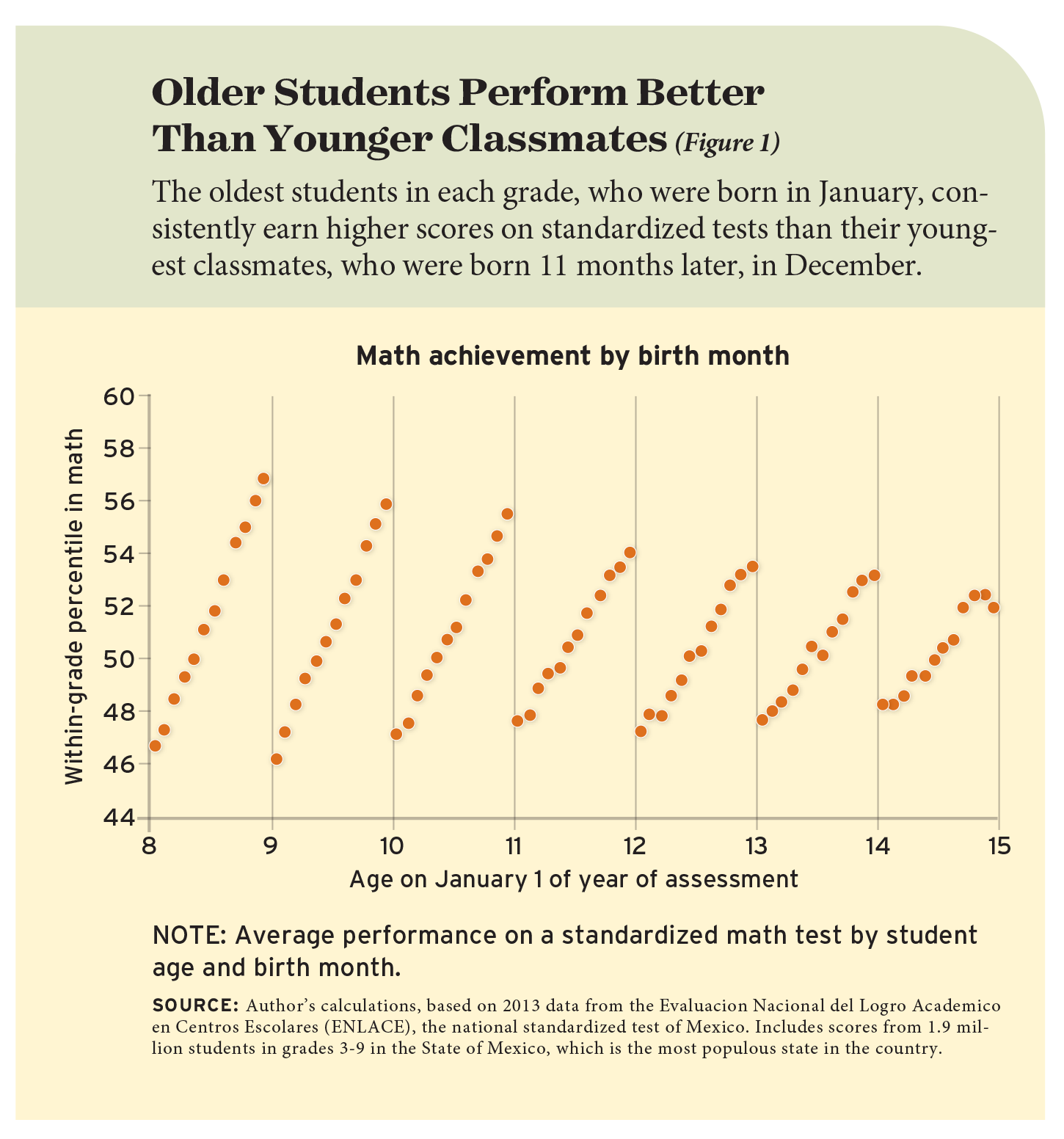

 The executive director of the Pioneer Institute, Jim Stergios, joins Paul E. Peterson to discuss the current state of Boston Public Schools, and whether control of the district should be taken over by the state.

 A professor of economics at Duke University, Peter Arcidiacono, joins Paul E. Peterson to discuss Arcidiacono new study, which examines how racial preferences for under-represented minorities affected admissions to Harvard University and the University of North Carolina at Chapel Hill.